Home › Past Courses › DIY Gabion Fence Course in Novosedly – 15 May 2026
DIY Gabion Fence Course in Novosedly – 15 May 2026
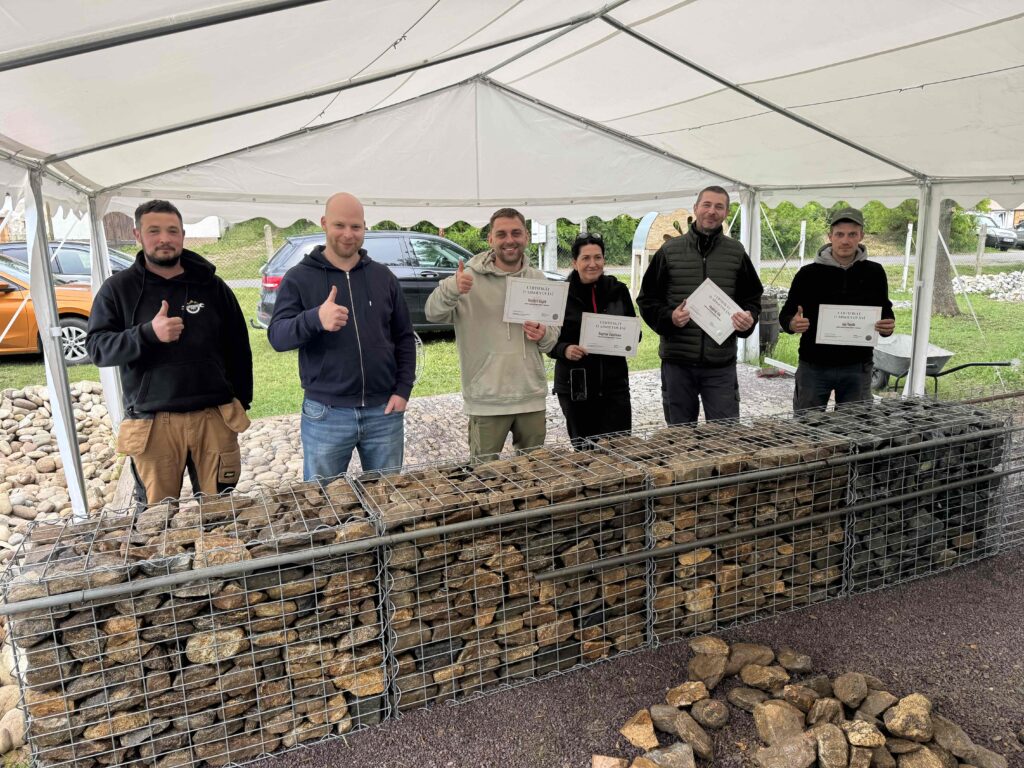
This practical session showed why a good gabion starts long before the basket is filled with stone. Participants worked on basket geometry, connectors, spacers, stone grading and careful hand placement of the visible face.
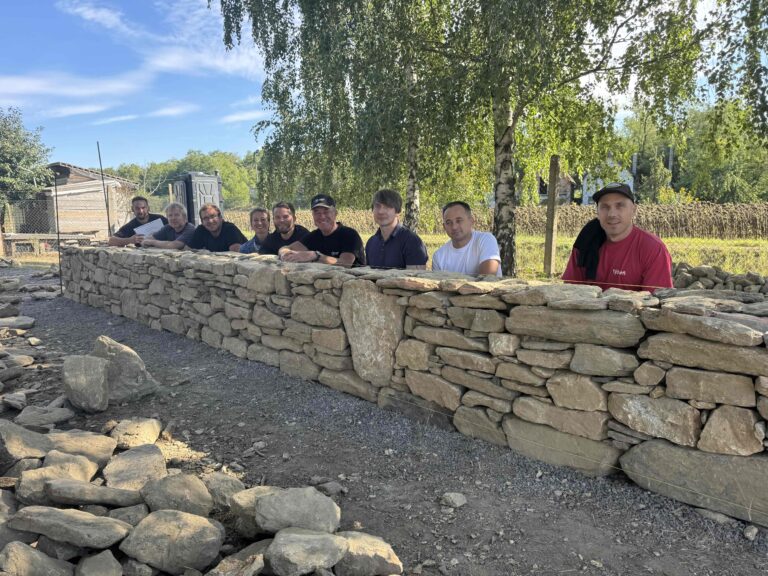
On Friday, 15 May 2026, we held another hands-on DIY gabion fence course in Novosedly, South Moravia, Czech Republic.
The day was not simply about assembling a wire basket, filling it with stone and calling the job finished.
Instead, the course focused on the parts of gabion construction that are often underestimated: base preparation, correct basket assembly, working with connectors and tools, spacers and cross ties, choosing the right stone size, hand-laying the visible face and continuously checking the shape of the basket while it is being filled.
A gabion is more than a wire cage filled with stone. If it is expected to remain straight, look clean and function properly over time, the details of the construction matter.
Who Joined the Gabion Course?
The group included people with very different backgrounds. Some arrived with a specific garden project already planned. One participant was considering a gabion fence, another a smaller retaining feature, while others wanted to find out whether building a gabion themselves was realistic.
One participant came from a completely different professional world: software development.
He joked that in the age of artificial intelligence it might not be a bad idea to learn something practical as well. At the same time, he had his own project at home, so the course combined both goals: learning a physical skill and understanding how a gabion should actually be built.
This is typical of our practical courses. Participants are not only professional tradespeople. We regularly meet people from offices, design professions, business and IT, as well as homeowners who simply want to understand a construction method before using it on their own property.
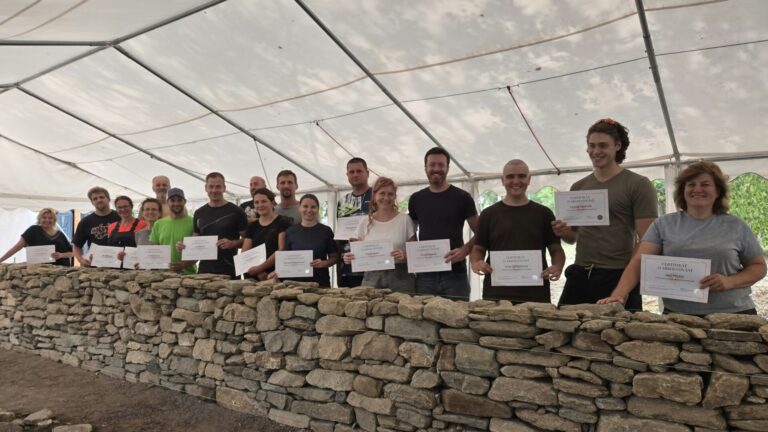
A Participant Returning for His Fourth Stonework Course
One participant was attending one of our courses for the fourth time.
Over time, he had taken practical training in:
traditional stone paving,
dry stone walling,
DIY gabion construction,
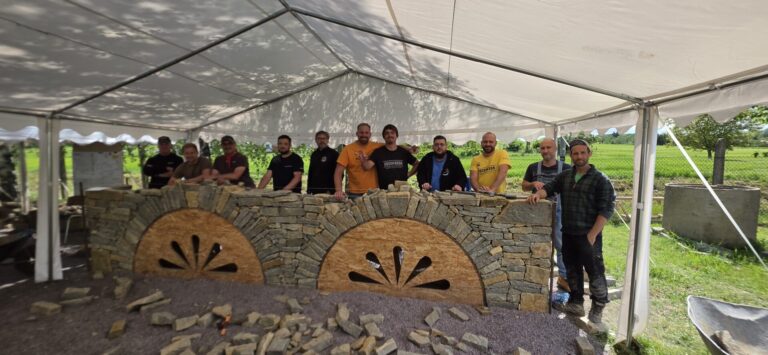
stone arch building.
For us, repeat participation is valuable feedback. Someone who returns for several different disciplines has already experienced the teaching style and practical format and has decided that continuing with another type of stonework is worthwhile.
A Visit from a Czech Sculpture and Stonemasonry School
The course also included a visit from a Czech secondary school specialising in sculpture and stonemasonry.
We discussed possibilities for future cooperation involving third-year students. The intention is not to replace school-based education, but to complement it with experience from real construction practice.
That can include topics such as working with clients, selecting materials, responding to site conditions, estimating work, dealing with mistakes, weather, logistics and taking responsibility for the finished result.
Learning how to shape stone is one part of the craft. Understanding how a real stonework project operates from planning to execution is another.
Practical cooperation can help students understand questions that are difficult to reproduce fully in a classroom:
how stone structures are assessed directly on site,
which mistakes repeatedly appear in real projects,
how communication with a customer affects the work,
how stonework can be estimated and priced,
how outdoor construction differs from classroom theory,
why preparation can be more important than the actual placement of stone,
where a simple garden structure ends and a construction requiring deeper technical design begins.
What We Actually Built during the Gabion Course
The main topic of the day was building a gabion fence yourself and understanding how a gabion basket works from preparation through to final stone filling.
Participants did much more than simply pour stone into a cage. They worked through the complete process:
preparing the site,
checking the supporting base,
assembling the gabion basket,
connecting the mesh panels,
working with the required tools,
using spirals, connectors and spacers,
filling the basket progressively in layers,
hand-laying the visible stone face,
working with different types of stone,
checking the basket geometry during filling,
understanding the difference between face stone and internal fill.
These details often determine the difference between a gabion that remains visually clean and straight and one that becomes uneven, bulges or develops a chaotic visible face.
Gabion Basket Assembly Comes before the Stone
A significant part of the course focused on assembling the gabion basket itself.
This quickly demonstrates that gabion construction is not mainly about physical strength. Accuracy and patience matter just as much.
Participants practised connecting individual basket sections, using the appropriate tools and checking the geometry of the structure. The basket needs to hold its intended shape before it is filled with heavy stone.
A common DIY mistake is to concentrate immediately on how the stone will look while paying too little attention to the wire structure that contains it.
If the basket is incorrectly assembled, stone pressure can make the problem progressively worse. The sides may begin to spread or wave, and correcting the geometry becomes much more difficult once the basket is full.
During the course we therefore covered:
how to assemble a gabion basket correctly,
where to check right angles and alignment,
how to connect individual mesh panels,
how the connecting elements are used,
why cross ties and spacers matter,
why the basket shape should be checked throughout construction rather than only at the end.
A mistake in a gabion often becomes most obvious only after the basket is full of stone. At that point, correcting it is considerably more difficult.
Gabion Base Preparation: Invisible but Important
Another major topic was the base beneath the gabion.
This part of the construction is normally hidden in the finished photographs, but it influences whether the gabion remains level, follows the intended line and performs properly over time.
For a simple garden gabion or lower gabion fence, important considerations can include:
the bearing capacity of the ground,
creating a level base,
drainage,
compaction,
the width and stability of the supporting layer,
integration with the surrounding terrain,
accurate positioning of the first basket or row.
Higher, retaining or otherwise heavily loaded structures require a different level of consideration. Drainage, backfill, geotextile, loads and potentially structural design may all become relevant.
During the course we therefore distinguished clearly between a straightforward garden gabion and a structure performing a more demanding retaining function.
Not every gabion is automatically a retaining wall, and not every retaining gabion should be designed only through DIY judgement.
Filling a Gabion with Fieldstone, Granite and Sandstone
Participants worked with several types of natural stone and could compare how different materials behave when used inside a gabion basket.
fieldstone,
granite,
sandstone,
and other stone.
Each type has a different shape and visual character.
Fieldstone can be more irregular and may require additional selection when forming a neat visible face. Granite can create a strong, defined appearance that works well with the technical character of gabion mesh. Sandstone can produce a softer and warmer visual effect, although the suitability of a particular stone still needs to be considered for the intended application.
The discussion therefore went beyond choosing the stone that simply looked best. Participants considered:
appropriate stone size,
which pieces are suitable for the visible face,
which stone can be used inside the basket,
why excessively small material can cause problems,
why using very large stone does not automatically produce a better result,
how different shapes can be combined,
how to avoid large voids within the filled basket.
The Visible Gabion Face Is Laid by Hand
One of the most important lessons of the day was simple:
The visible face of a gabion should be laid by hand.
This is one of the main differences between a gabion that looks like an intentional stone structure and one that appears to be a random pile of stone inside wire mesh.
Stones for the visible face are selected according to their shape, dimensions and usable surface. They are positioned to create a consistent and visually controlled frontage.
The internal part of the basket can then be filled with suitable stone that does not need the same visual quality, but the filling still needs to be controlled.
A better approach is to work progressively in layers:
establish the first layer,
hand-lay the visible stones,
fill the internal section,
check the basket shape,
install the required spacers or cross ties,
continue with the next layer.
This is also one of the parts of gabion construction that becomes much clearer through hands-on practice. Natural stone is irregular, so the builder has to make decisions continuously rather than follow one identical pattern for every piece.
Gabion Spacers and Cross Ties: Small Parts with an Important Role
Another important topic was the use of spacers and cross ties.
These elements help maintain the correct distance between opposing basket faces and reduce the tendency of the mesh to bulge outward as the weight of the stone increases.
This is particularly visible on longer gabion fences. Even relatively small distortions can become obvious when repeated over several metres.
The shape of the gabion therefore needs to be checked continuously while the basket is being filled, not only after the final stone has been placed.
You do not check the geometry of a gabion only after it is finished. By then, you are usually identifying problems rather than preventing them.
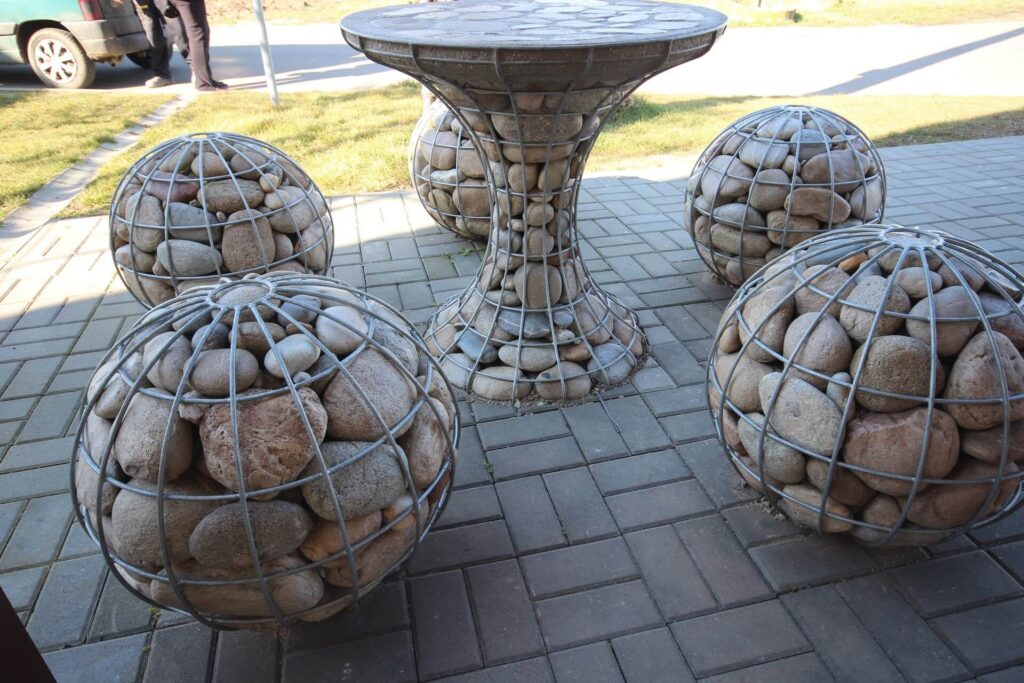
Gabion Seating as an Additional Garden Feature
In addition to the gabion fence, participants could also explore the principle of gabion seating.
Gabions do not have to function only as fences or retaining structures. They can also be incorporated into benches, seating elements, garden dividers, raised terrace edges and other landscape features.
With seating, additional questions appear: finished height, stability, the top surface, user comfort and the connection between the gabion structure and timber or another seating material.
Stone-filled gabion seating.
Who Is the DIY Gabion Course For?
The practical course is primarily intended for people who want to build a gabion themselves but would prefer to understand the principles before learning through expensive trial and error.
It can be useful if you are planning:
a gabion fence around a house,
a gabion privacy screen,
a smaller retaining feature,
gabion seating,
a garden divider,
a combination of gabion and timber,
a natural-stone feature beside a modern house,
or simply want to understand whether DIY gabion construction is realistic for you.
The course is suitable for beginners and previous construction experience is not required. The important part is being willing to work practically and understand the principles behind the finished structure.
What Participants Took Away from the Course
The aim of the day was not to turn anyone into a specialist in every possible gabion structure.
Instead, participants left with a much clearer understanding of:
why the supporting base matters,
how a gabion basket is assembled,
why spacers and cross ties are used,
how stone size affects filling,
why the visible face is laid by hand,
the difference between visible face stone and internal fill,
why basket geometry needs to be checked throughout construction,
when a gabion is a straightforward garden element,
and when a more technical design may be required.
That is the purpose of the course: not to make someone a professional gabion builder in one day, but to provide a practical foundation so they do not begin their own project completely blind.
Hands-On Stonework Courses in South Moravia
Our courses take place in Novosedly, South Moravia, Czech Republic, near Mikulov. Training takes place in a real outdoor working environment rather than a classroom.
Participants work with actual stone, gabion baskets and tools and can see the kinds of small mistakes that naturally occur during construction.
Those mistakes are often one of the most useful parts of practical training, because correcting them during a supervised course is considerably easier than discovering them later on your own finished project.
Want to Learn Practical Gabion Construction?
If you are planning a gabion fence, garden screen, seating element or another smaller gabion structure, practical training can help you understand the construction principles before starting your own project.
Our stonework course programme includes practical training in several different types of natural-stone construction.
He is responsible for website content, course organisation and turning practical stonework experience into useful information for people who want to build with natural stone themselves or learn the craft.
He has worked with natural stone since 1998. His experience includes stone walls, paving, cellars, arches and historic reconstruction, and he also passes on his practical stonework knowledge through hands-on courses.
Stonework since 1998
Dozens of projects
Hands-on teaching
We use cookies on our website. Some are essential, while others help us improve the website and your experience. Do you consent to the use of all cookies?
Functional
Always active
Technical storage or access is strictly necessary for the legitimate purpose of enabling the use of a specific service explicitly requested by the subscriber or user, or solely for the purpose of transmitting a communication over an electronic communications network.
Preferences
Technical storage or access is necessary for the legitimate purpose of storing preferences that are not requested by the subscriber or user.
Statistics
Technical storage or access that is used exclusively for statistical purposes.Technical storage or access that is used exclusively for anonymous statistical purposes. Without a subpoena, voluntary compliance by your Internet Service Provider, or additional records from a third party, information stored or retrieved for this purpose alone generally cannot be used to identify you.
Marketing
Technical storage or access is required to create user profiles for advertising purposes or to track the user on this website or across several websites for similar marketing purposes.
Nezávazně se zapiš a měj přehled dřív než ostatní.
Ne každý je ready připravenhned. Nech mi e-mail a pošlu ti nové termíny, uvolněná místa i důležité info ke kurzu. Bez objednávky, bez platby a bez závazku.