

A DIY gabion fence may look simple, but small construction errors quickly become visible once several tonnes of stone begin pressing against the mesh. The quality of the finished fence depends not only on the stone, but also on the base, accurate basket assembly, correct connections, internal bracing and the way the baskets are filled.
| This guide covers | DIY gabion fences and other common garden gabion structures |
| Main risks | Bulging baskets, poor alignment, an uneven visible face and unsuitable stone |
| Key principle | Do not wait until the basket is full to check it – geometry needs to be monitored throughout filling |
| Important components | Base, baskets, connectors, bracing ties, suitable stone and hand-laid visible faces |
| When technical design may be needed | Higher, longer or retaining structures, especially where the gabion supports soil |
| Practical training | Hands-on gabion construction is included in our practical stonework course programme |
What Is a Gabion Fence and When Does It Make Sense?
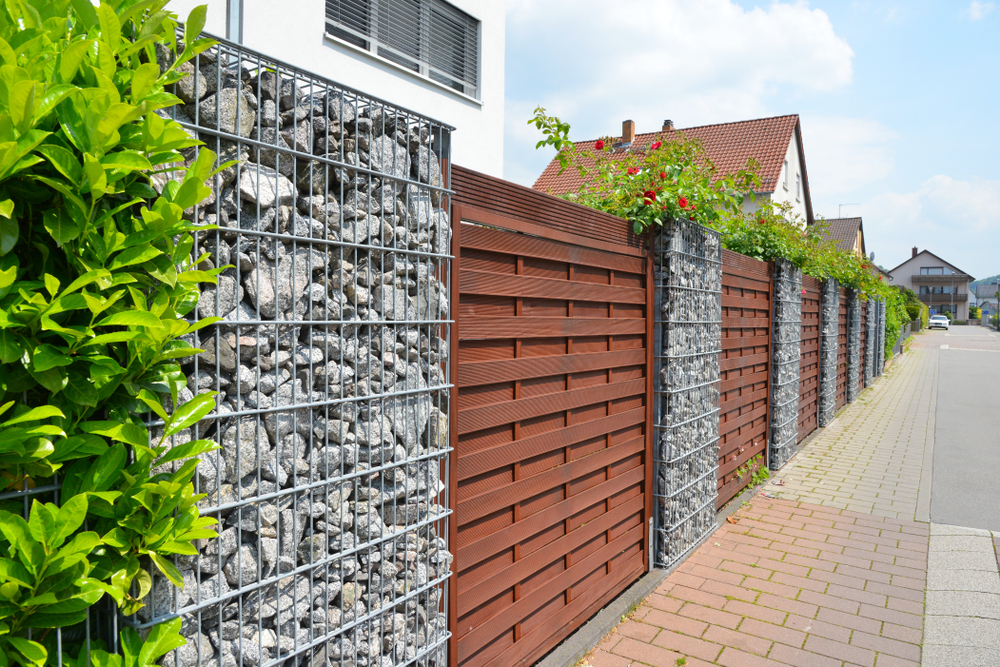
A gabion fence is built from wire baskets or mesh panels that are assembled and then filled with stone. Depending on the design, gabions can be used as fences, privacy screens, garden dividers, low walls or, in some cases, retaining structures.
The important question is what the gabion is actually expected to do.
A low decorative fence between two parts of a garden is a very different structure from a gabion that retains soil or deals with a significant change in ground level.
The taller, longer and more heavily loaded the structure becomes, the less appropriate it is to rely only on a general online DIY guide.
When a Simple DIY Guide Is No Longer Enough
A straightforward garden gabion fence may be suitable for DIY construction if the correct system is used and the work is carried out carefully.
However, more detailed design should be considered when the gabion:
- is relatively high,
- acts as a retaining structure,
- holds back soil or a slope,
- forms part of complicated terrain,
- is long and visually dominant,
- or carries additional structural elements.
Depending on the situation, this may require a specific technical design or assessment by a structural engineer.
A gabion is not simply decorative stone inside wire mesh. It is a construction that needs to work technically as well as visually.
1. The Base Matters More than Many DIY Builders Expect
One common mistake is assuming that a gabion basket can simply be placed on existing ground, roughly levelled during installation and then stabilised by the weight of the stone.
It cannot.
A gabion fence needs a level, stable and load-bearing base. If the supporting layer is uneven, soft or likely to move, those problems will be transferred into the finished structure.
The result may be an uneven top line, inconsistent basket width or visible deformation between individual sections.
The exact base construction depends on the gabion system and site conditions, but the principle remains the same: the baskets need to stand on a stable and accurately prepared support.
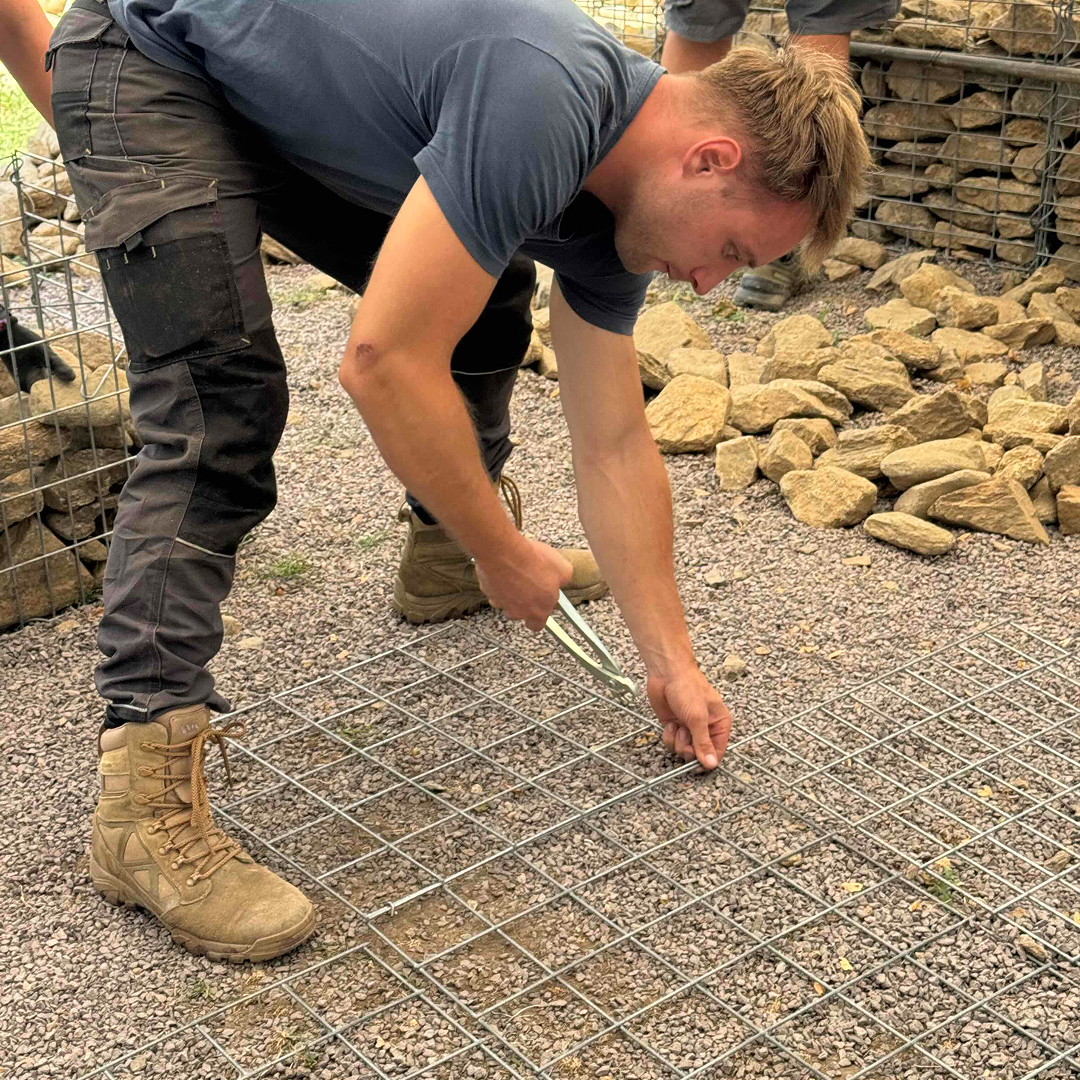
2. Assemble the Gabion Baskets Accurately from the Start
Another common problem begins during basket assembly. It is tempting to assume that small inaccuracies will disappear once the basket is filled with stone.
In reality, the weight of the stone often makes those inaccuracies more obvious.
The baskets should therefore be assembled carefully and according to the requirements of the particular system being used.
Check the position of the mesh panels, corner connections and overall geometry before filling begins.
3. Basket Connections Depend on the System
Different gabion systems use different methods for connecting mesh panels. These may include spirals, C-rings, clips or other manufacturer-specific connectors.
The objective is not simply to attach one mesh panel to another in any convenient way.
The connection method should correspond to the manufacturer and basket system being used.
Incorrect or inadequate connections can affect the geometry of the basket once pressure from the stone begins to increase.
Corners, panel joints and connections between adjacent baskets are therefore not minor details. They are important parts of the complete gabion system.
4. Bracing Ties and Spacers Are Essential
One of the most common DIY mistakes is underestimating the importance of internal bracing ties, spacers or stiffeners.
These elements connect opposing faces of the basket and help prevent the mesh from spreading outward as the stone is added.
If they are omitted, incorrectly positioned or used in insufficient numbers, the basket can begin to bulge during filling.
Once the basket is completely full, correcting that deformation becomes much more difficult.
“A gabion is not ruined only at the end. Problems develop during filling when the basket shape is not monitored and the internal bracing is underestimated.”
Luděk Komoň Sr.
5. How to Choose the Right Stone for a Gabion
Choosing gabion stone is not simply a matter of colour or stone type. Saying “we will use granite” or “we want grey stone” is only the beginning.
You also need to consider:
- stone size in relation to the mesh aperture,
- stone shape,
- colour and visual character,
- whether the pieces can be hand-laid effectively on the visible face,
- how the internal part of the basket will be filled.
The stone should be large enough not to pass through the mesh and suitable for creating the intended visible face.
A stone that looks attractive in a stockpile is not automatically suitable for a visually exposed gabion fence.
6. Do Not Pour the Visible Face – Lay It by Hand
This is one of the most important differences between an attractive gabion fence and an average result.
The visible face of a well-finished gabion is laid by hand.
Suitable stones are selected and positioned so the front face appears compact, controlled and visually consistent.
If the entire basket is simply filled indiscriminately from a shovel or wheelbarrow, the visible surface is likely to appear random, uneven and full of unwanted gaps.
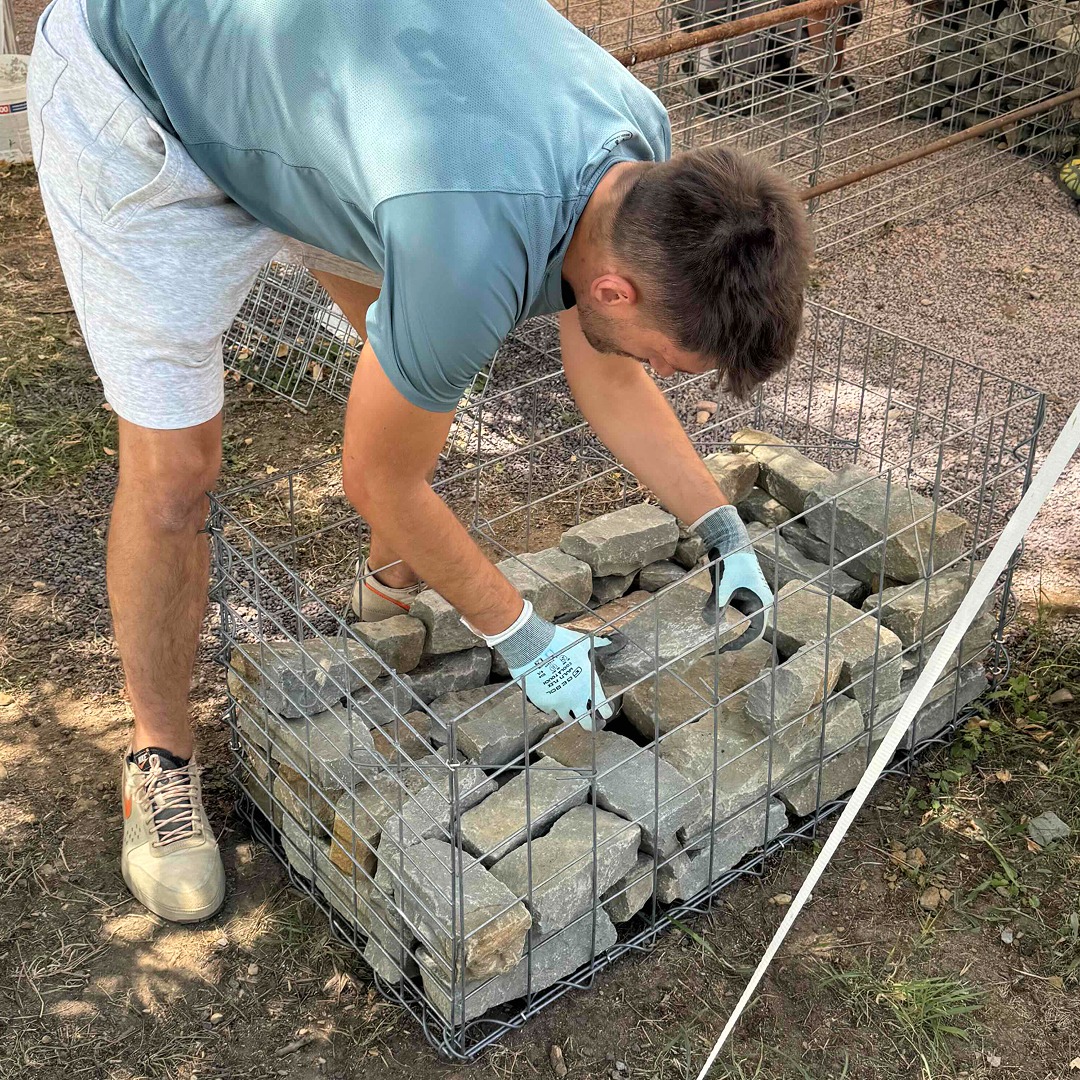
7. The Inside of the Basket Is Filled Differently from the Visible Face
The visible stone face and the internal filling of the basket perform different roles.
On an exposed gabion fence, the front face normally receives more careful hand placement. The internal section still needs to be filled in a controlled way so that the basket remains stable and large unwanted voids are avoided.
The combination of a well-laid face and properly filled interior influences both the immediate appearance and the long-term shape of the structure.
8. Fill the Gabion in Layers and Check Its Shape Continuously
A gabion should not be filled by simply loading stone to the top and attempting to straighten everything afterwards.
Instead, fill the basket progressively in layers and check the following throughout the work:
- the plane of the visible face,
- vertical alignment or the intended geometry,
- basket width,
- correct operation of the bracing ties,
- corners and connections,
- the developing top line.
Once the basket is completely full, the opportunity for easy correction decreases dramatically.
9. Why Do Gabion Baskets Bulge?
Gabion bulging is rarely caused by one single error. It is usually the result of several problems acting together.
- insufficient or poorly positioned bracing ties,
- incorrect basket assembly,
- uneven or unsuitable filling,
- failure to monitor basket geometry during filling,
- poor stone grading or stone selection,
- filling too quickly and without control.
Adding more stone does not straighten a badly prepared basket. In many cases, the additional pressure makes the deformation more visible.
10. Geotextile and the Area behind the Gabion
Where a gabion borders soil or separates different construction layers, geotextile and the area behind the structure may also need to be considered.
The purpose is not simply to install geotextile because “that is what people do”. The important question is what the geotextile needs to separate and how water and fine particles will move through the area.
With retaining or partially retaining gabions, drainage and the layers behind the structure become particularly important.
At this point the gabion needs to be considered as a technical construction rather than only as a visual garden feature.
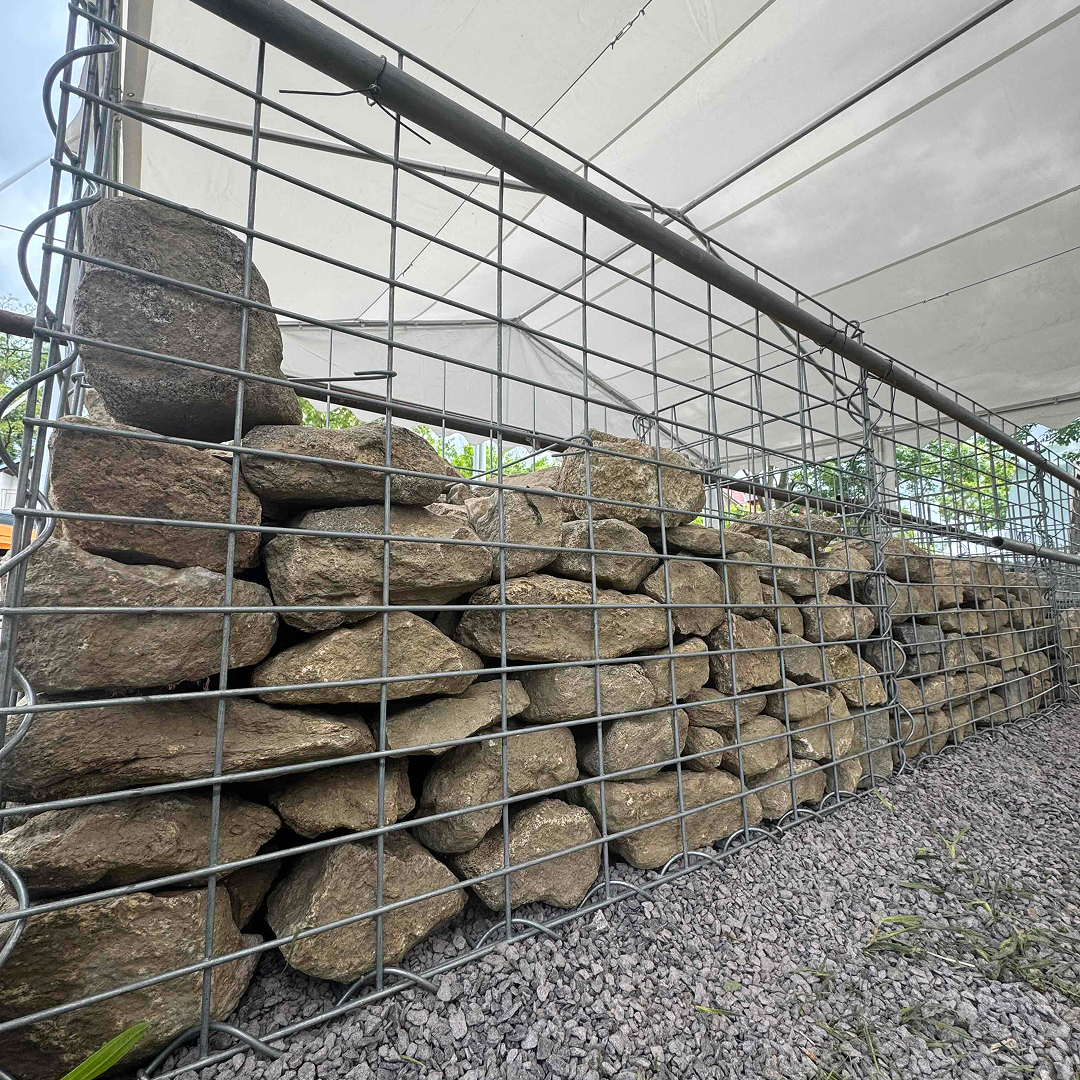
11. Training Photos Are Not Always Finished Construction Details
Photographs of gabion construction can easily be misunderstood when they are viewed without context.
The photograph below, for example, does not show the final connection between completed baskets. It was taken during a hands-on gabion construction course, where individual gabion blocks were temporarily positioned next to one another for training purposes.
The spiral corner connectors are therefore intentionally visible outside what would be their final finished position.
The image should be understood as a training-stage photograph rather than a finished construction detail.
12. What Does a Well-Built Gabion Fence Look Like?
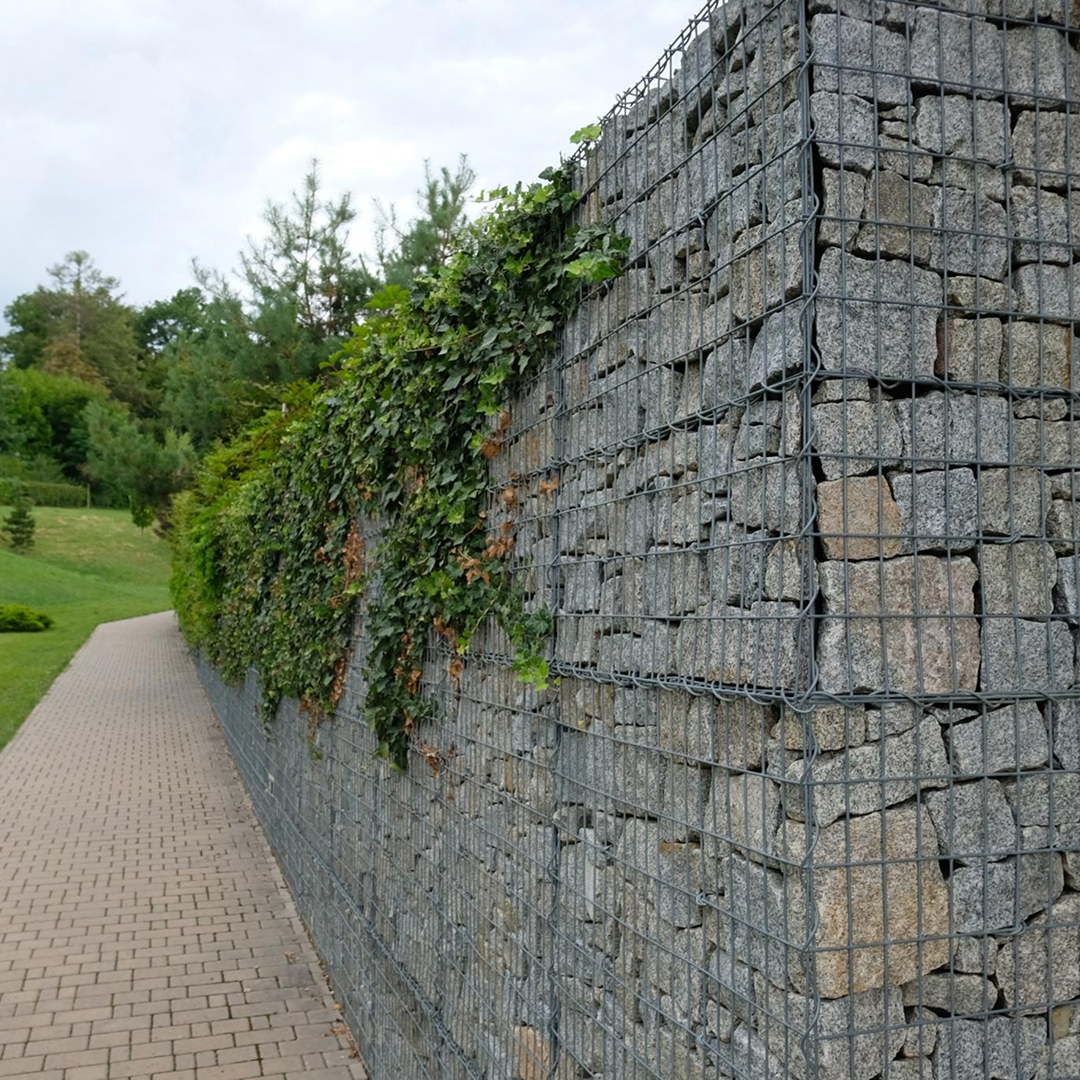
A well-built gabion fence is usually easy to recognise.
- the baskets remain straight,
- the visible face has been deliberately laid,
- the top line is consistent,
- the stone appears compact rather than randomly dumped,
- individual sections follow the intended geometry.
The finished appearance reflects more than simply filling a wire basket with stone. It is the result of careful work with material, geometry, connections and detail.
Most Common DIY Gabion Fence Mistakes
| Mistake | Typical consequence |
|---|---|
| Poorly prepared base | An uneven or unstable fence from the beginning |
| Inaccurately assembled baskets | Misalignment that becomes more obvious after filling |
| Insufficient bracing | Basket faces bulging outward under stone pressure |
| Incorrect stone size | Poor appearance, stones passing through the mesh or difficult face construction |
| Dumping stone without hand-laying the visible face | A random and visually inconsistent frontage |
| Filling without checking geometry | A distorted structure that is difficult to correct once finished |
| Treating gabions only as decoration | Technical details of the construction are underestimated |
| Using the same approach for a fence and a retaining structure | Potentially unsafe oversimplification of a more demanding structure |
How to Build a Gabion Fence Step by Step
| Step | What to consider |
|---|---|
| 1. Assess the site | Function, height, length, connections to surrounding structures and possible loads |
| 2. Prepare the base | Create a level, stable and load-bearing support |
| 3. Assemble the baskets | Connect panels accurately and check basket geometry |
| 4. Use the correct connection system | Install spirals, clips, rings or other system-specific connectors correctly |
| 5. Install bracing | Position spacers, hooks or cross ties correctly |
| 6. Select the stone | Consider size, shape, colour and suitability for the visible face |
| 7. Hand-lay the visible face | Build the exposed frontage deliberately instead of simply pouring the stone |
| 8. Fill the interior | Fill progressively and avoid large uncontrolled voids |
| 9. Check the geometry | Monitor face alignment, width, height and overall shape throughout filling |
| 10. Finish the structure | Check the top line, connections and overall appearance before closing the basket |
Want to Try Gabion Construction Hands-On?
Our practical stonework programme includes hands-on gabion training where participants work with basket assembly, connectors, bracing ties, stone selection, hand-laid visible faces and continuous geometry checks during filling.
If you already have your own project, bring photographs, dimensions or a simple sketch so the relevant principles can be discussed in relation to your planned construction.
Frequently Asked Questions about Building a Gabion Fence
How do you build a gabion fence yourself?
Begin with a stable and level base. Assemble the baskets accurately, connect the mesh panels according to the selected system, install the required bracing and then fill the baskets progressively with stone. Hand-lay the visible face and check the geometry throughout the filling process.
What stone is suitable for a gabion?
The stone needs to be large enough in relation to the mesh aperture and suitable for the required visual finish. Important factors include stone size, shape, colour and whether individual pieces can be positioned effectively on the visible face.
Why does a gabion basket bulge?
Common causes include insufficient or badly positioned bracing ties, inaccurate basket assembly, uncontrolled filling and failure to monitor the shape of the basket as the stone is added.
Does the visible face of a gabion need to be laid by hand?
If a clean and controlled appearance is important, yes. The exposed face is normally hand-laid using selected stones. Simply pouring all of the stone into the basket usually produces a much more random appearance.
When does a gabion need structural design?
More detailed technical or structural design should be considered for higher, longer or retaining gabions, particularly where the structure supports soil, deals with significant loads or forms part of complicated terrain.
What can I learn on a practical gabion course?
Practical training can cover basket assembly, panel connections, bracing ties, stone selection, hand-laying the visible face and checking the geometry of the structure as the basket is progressively filled.
Who Is Behind This Article